
How to Teach the Circle of Fifths: A Printable Chart and Lesson Ideas for Piano Teachers
The circle of fifths shows up in almost every piano lesson, whether you name it or not. Key signatures, scales, chord progressions and transposition all come back to it. Students who understand the circle stop memorizing key signatures one at a time and start seeing how all twelve keys connect.
Here's how the circle works, how to introduce it in lessons, and how to keep it in front of students every week.
What Is the Circle of Fifths?
The circle of fifths arranges all twelve major keys, and their relative minors, in order by perfect fifths.
Moving clockwise from C adds one sharp to the key signature: C, G, D, A, E, B, F♯.
Moving counterclockwise from C adds one flat to the key signature: F, B♭, E♭, A♭, D♭, G♭.
At the bottom of the circle, the sharp and flat sides meet. F♯ major and G♭ major sound the same and are written differently
Relative minor keys sit inside the circle, next to the major key that shares their key signature: A minor with C major, E minor with G major, D minor with F major, and so on.
What the Circle of Fifths Helps Students Do
Read key signatures faster
The order of sharps (F, C, G, D, A, E, B) and the order of flats (B, E, A, D, G, C, F) follow the circle. Once students see the pattern, a key signature with four sharps isn't a fact to memorize. It's four steps clockwise from C.
Find relative minors
Every major key shares a key signature with a minor key. The circle puts each pair side by side, so students can find the relative minor without counting down a minor third every time.
Understand chord progressions
Neighboring keys on the circle are closely related. In C major, the IV chord (F) sits one step counterclockwise and the V chord (G) sits one step clockwise. Progressions like ii–V–I move around the circle, which is why they sound so natural.
Practice scales in a logical order
Working through scales clockwise adds one new sharp at a time. Students build on what they already know instead of starting over with each new key.
Transpose and improvise
When a student wants to move a piece to another key, or improvise over a progression, the circle shows which keys and chords are closest.
A Printable Circle of Fifths Chart for Your Studio
The easiest way to make the circle part of every lesson is to keep it on the wall where students can see it.
Our Circle of Fifths Posters come as print-ready PDFs in four styles: plain black and white, warm vintage paper, warm watercolor paper and cool light paper. They're sized for a standard 12×18 poster and scale cleanly to other sizes, so you can print one for the studio or a smaller copy for a student's binder.

A Circle of Fifths poster designed to be both functional and visually cohesive with modern piano teaching spaces.
This printable includes four styles, giving you flexibility to choose what fits your studio aesthetic:
Plain black and white
Warm, vintage paper texture
Warm, watercolor paper texture
Cool, light paper texture
All versions are provided as print-ready PDFs, sized to the standard 12×18 poster format and designed to scale cleanly to other sizes without loss of clarity.
Ideal for studios that want theory visuals that feel intentional, polished, and worth hanging on the wall.
🖥️ Instant PDF download — 4 pages. No physical item will be shipped.
A Circle of Fifths Wall Clock
If you'd rather have something that works as both a teaching tool and studio decor, the Circle of Fifths Wall Clock is a 10″ × 10″ clock with a musically accurate circle of fifths on the face. It has a silent movement, so no ticking competes with your lessons. It also makes a thoughtful gift for a piano teacher or a student studying theory.
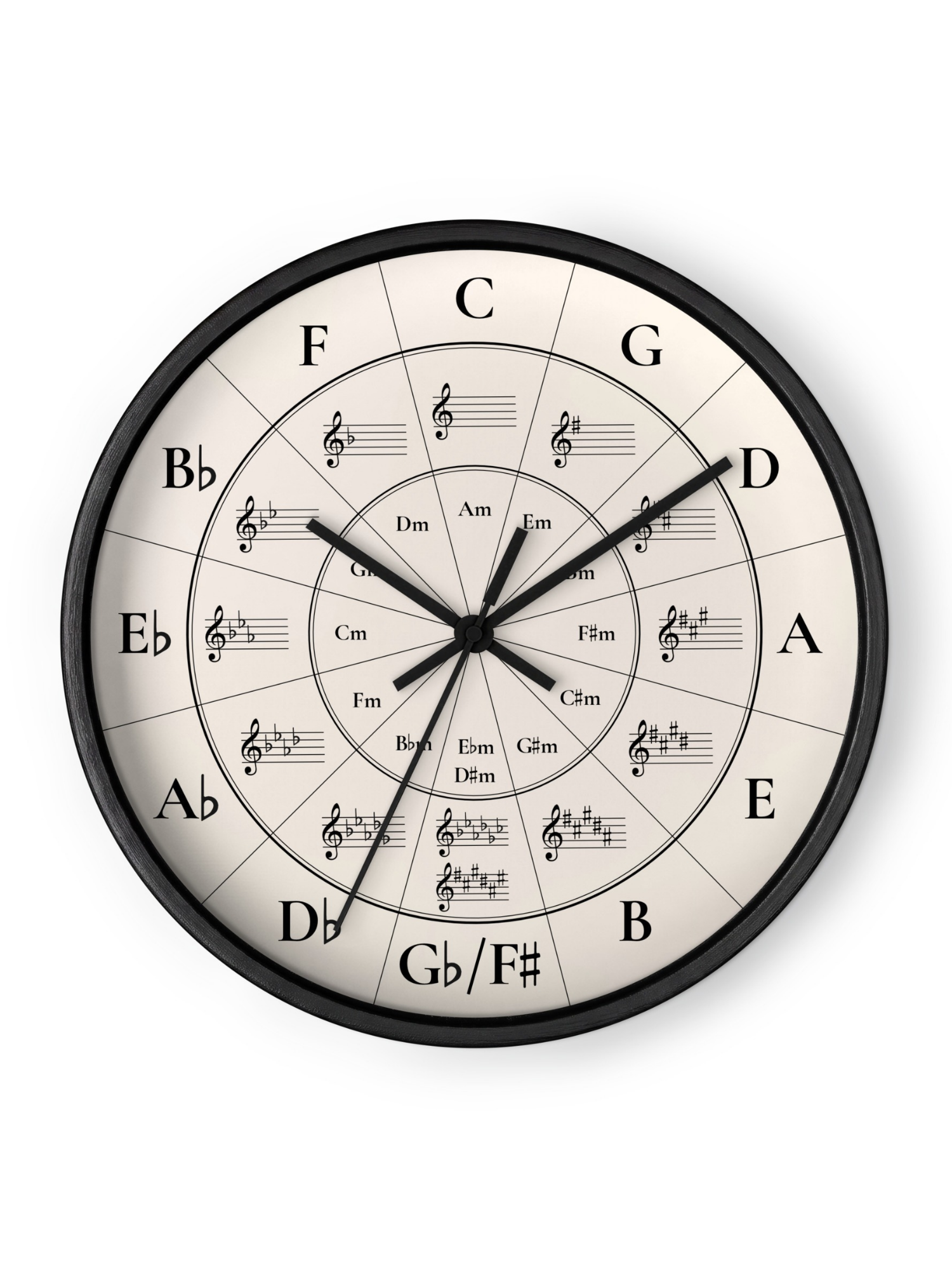
A functional teaching tool disguised as beautiful studio decor.
This 10" × 10" Circle of Fifths clock is 100% musically accurate and designed by a musician. Keep it in your teaching space for quick visual reference during lessons or simply enjoy it as a thoughtful piece of music-room decor.
Its silent movement means no distracting ticking competing with your music.
Made to order. Estimated U.S. delivery: 6-9 business days. International delivery estimates vary by destination.
Order by Dec 10 to ensure Christmas delivery to the U.S.
Make It a Weekly Habit
The circle of fifths is most useful when students see it all the time, not just the week you teach it. Keep a chart where everyone can see it, refer to it whenever a new key comes up, and students will start using it on their own.
Looking for more hands-on theory tools? Read The Complete Guide to Magnetic Music Notes for Piano Teachers.