
20 Magnetic Music Note Activities for Piano Lessons, Group Lessons & Music Classrooms
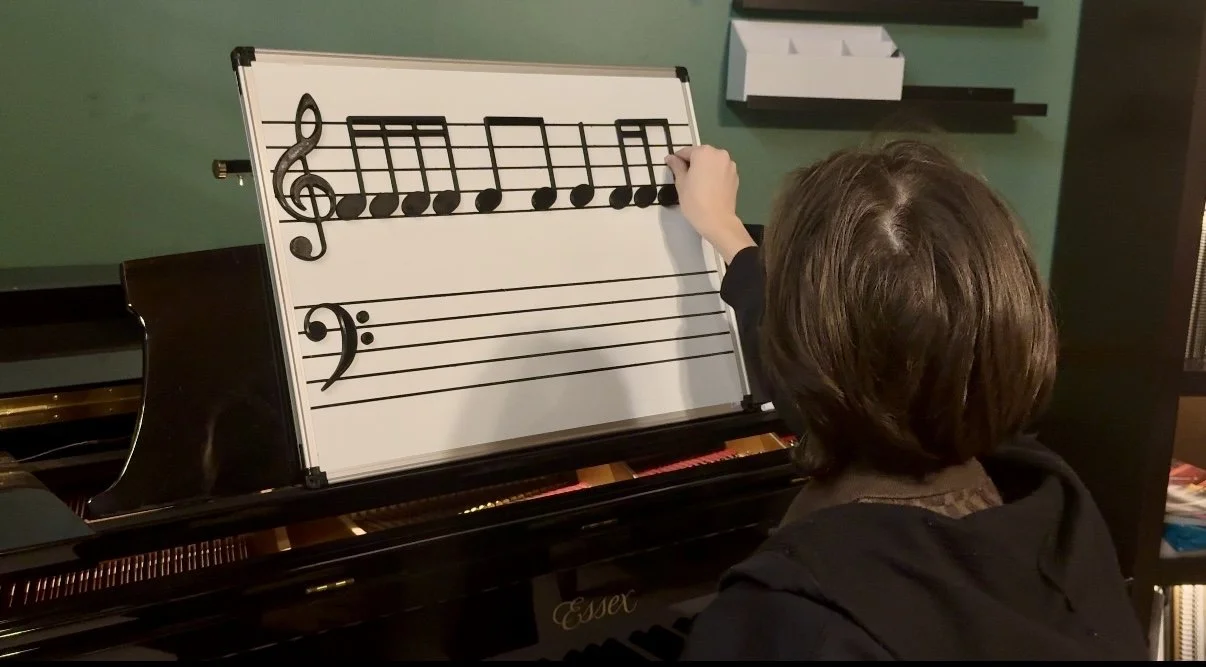
Magnetic music notes are one of the easiest ways to make reading, rhythm, and theory instantly clearer for students. Whether you teach private lessons, small groups, partner lessons, or large classrooms, hands-on manipulatives turn abstract concepts into something students can see, touch, and understand.
Below are 20 teacher-tested activities you can use with Sound Shapes to strengthen reading, build confidence, and make lessons more interactive.
To review how to teach students to read notation before adding activities, visit How To Teach Piano Students To Read Music On The Staff.
1. Gem Gather (Staff Movement Game)
Students roll the dice and move their game pieces on the keyboard and corresponding staff, racing up to the highest G, then back down to the lowest. This simple game reinforces how movement on the staff corresponds to movement on the keyboard.
Great for: directional reading, keyboard–staff correlation
You can download the free Gem Gather printable here, which includes setup and gameplay directions.
2. Make It Major / Make It Minor
Place a pentascale, full scale, or chord on the staff. Give students accidentals and challenge them to transform it into major or minor. Can also play either major or minor on the keyboard and they must place accidentals to match what they heard.
Great for: ear training, accidentals, scale construction, chord quality.
3. Pentascale & Scale Builder
Students place notes on the staff to build pentascales, full scales, or modal patterns.
Great for: interval patterns, half-step/whole-step structure, theory fluency.
4. Copy the Measure
Have students recreate a measure from their music exactly as printed. This reveals how they process spacing, rhythm, and direction.
Great for: notation comprehension, visual processing, error detection.
5. Spell the Word
Call out or display simple words and have students spell them on the staff.
Great for: note naming, line/space orientation, quick wins for beginners.
6. Rhythm Drills
Place rhythm patterns on the board and have students add beat numbers underneath, clap them, and then play them on a given note.
Great for: counting skills, rhythm accuracy, internal pulse.
7. Note Naming Drill
Place several notes on the staff. Students write the letter names, then play each one on the piano. Add a timer and have students try to beat their best time every week.
Great for: fast review, reinforcement, keyboard mapping.
8. Note Placing Challenge
Write letters on the board and have students place the correct notes on the staff under or above them.
Great for: reversing the note-naming process, kinesthetic reinforcement.
9. Compose a Short Melody
Give students a starting note and ask them to build a four- or eight-note melody using steps, skips, or a mix.
Great for: composition skills, interval intuition, creative exploration.
10. Chord Quiz
Place triad shapes or seventh chord shapes on the staff. Students identify the chord and locate it on the piano.
Great for: chord fluency, reading harmony, pattern recognition.
11. Rhythm Composer
Give students a time signature and a bank of note values. Their task: create a measure that adds up correctly, then play it.
Great for: math skills in rhythm, composition, improvisation.
12. Step-Skip Path
Place a starting note on the staff, then have students add notes one by one by giving them directions: step up, skip down, etc. Can also play the intervals on the piano and student must place notes based on what they hear.
Great for: intervallic reading, aural skills, melodic dictation.
13. Interval Builder
Call out an interval (major 3rd, perfect 5th, etc.). Students build it on the staff from any note you choose.
Great for: harmonic and melodic interval fluency.
14. Error Detection
Deliberately place one or more mistakes in a measure — bass clef dots in wrong spot, notes not being fully on a line or space, too many beats in a measure etc. Students must fix the errors.
Great for: problem-solving, detail-oriented reading.
15. Melodic Dictation
Play a short 3–5 note pattern and have students recreate it on the magnetic staff.
Great for: ear training, melodic dictation,
16. Rhythm Dictation
Play a rhythm on the piano then have students recreate it on the board.
Great for: ear training, rhythm dictation.
17. Sight Reading
Quickly create short sight reading excerpts for students to play. Students can play notes as soon as you place them or play melodies after they’re constructed.
Great for: sight reading, speed reading.
18. Pin the note on the staff
In group lessons: students must place their note on a given note on the staff while blindfolded. They will need to feel the staff lines and have a deep understanding of where notes are placed in order to be successful.
Great for: group engagement, note placement.
19. Key Signature practice
Students must build key signatures with the correct order of sharps and flats.
Great for: key fluency, accidentals, theory reinforcement.
20. Rhythm Freeze Game
Clap or play a rhythm pattern. Students build it on the board — but when you say “freeze,” they must stop mid-measure and explain what comes next.
Great for: rhythm logic, quick thinking, concept retention.
Want Magnetic Notes Sized for a 1-Inch Staff?
Sound Shapes is the only magnetic music-note system designed specifically for piano teachers, offering accurate notation, durable materials, and a complete symbol library for every teaching level.
If you’d like to explore the sets used in these activities, you can view them here: Shop Sound Shapes
For a detailed look at how Sound Shapes differs from other magnetic systems, see Magnetic Music Notes Comparison: Why Teachers Choose Sound Shapes.